Break-Even Point
Break-even point is the time it takes for refinance savings to recover the upfront cost of the new loan.
Break-even point is the time it takes for refinance savings to recover the upfront cost of the new loan.
Why It Matters
Break-even point matters because a refinance is not automatically smart just because the new rate is lower. Borrowers need to know how long they must keep the new loan for the savings to outweigh the upfront cost.
It also matters because many refinance pitches focus on the new monthly payment without forcing the borrower to think about time horizon. If the borrower expects to sell, refinance again, or move soon, the break-even math may change the decision completely.
This page matters because break-even point is one of the clearest ways to turn refinance marketing into borrower decision logic. It forces the borrower to connect cost, savings, and expected time in the loan.
Where It Appears in the Borrower Process
Borrowers encounter break-even-point analysis when comparing refinance options and deciding whether the transaction fits their expected time in the home and loan.
The term becomes most practical after the lender has given enough pricing detail for the borrower to compare cost versus savings realistically.
It becomes especially practical when a borrower is comparing a lower-rate refinance with a no-closing-cost option and needs a simple way to judge how long each structure needs to work before it starts helping.
Break-Even Formula
$$ \text{Break-even months} = \frac{\text{Total upfront refinance cost}}{\text{Monthly savings}} $$
In plain language:
- total upfront refinance cost means the closing-related cost the borrower still has to recover
- those costs are usually the Refinance Closing Costs that remain economically tied to the deal
- monthly savings means the reduction in the ongoing payment or other monthly borrowing cost the borrower is actually counting on
- if monthly savings are zero or negative, there is no positive break-even point
Quick Inputs
| Input | What it means | Example |
|---|---|---|
| Total upfront refinance cost | Costs the borrower still needs to recover through savings | $3,600 |
| Old monthly payment | Relevant old required payment before the refi | $2,150 |
| New monthly payment | Relevant new required payment after the refi | $1,950 |
| Monthly savings | Old payment minus new payment | $200 |
| Break-even point | Months needed to recover costs | 18 months |
Practical Example
A refinance reduces the monthly payment, but the borrower must pay several thousand dollars in upfront costs. If the borrower pays $3,600 in upfront cost and saves $200 per month, the break-even point is:
$$ \frac{3600}{200} = 18 \text{ months} $$
That means the borrower would need to keep the new loan for longer than 18 months before the savings move from recovery mode into real net benefit.
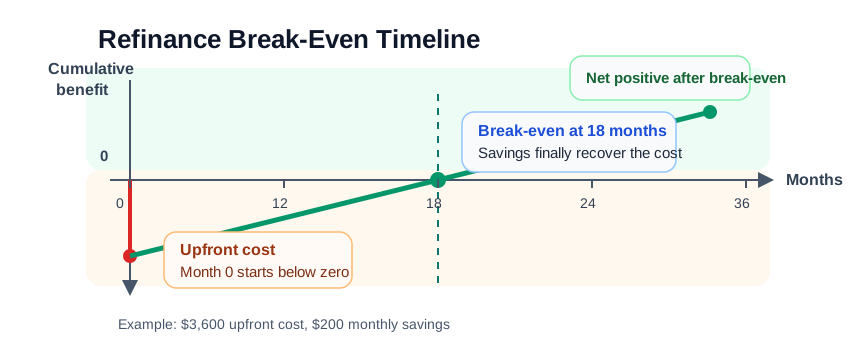
The diagram shows the same idea visually: the borrower starts below zero because of upfront cost, climbs back through monthly savings, and only becomes net-positive after the break-even month.
How It Differs From Nearby Terms
Break-even point differs from No-Closing-Cost Refinance because no-closing-cost refinance is one structural way to reduce upfront cash needs, while break-even point is the decision metric used to judge whether the refinance economics make sense.
It also differs from Refinance Closing Costs. Refinance closing costs are the input cost being recovered, while break-even point is the timing calculation built from that cost and the expected savings.
It also differs from APR. APR is a broad cost metric built into the loan disclosure framework, while break-even point is the borrower’s practical timing analysis for a refinance decision.
It also differs from Net Tangible Benefit. Break-even point is one timing calculation inside the decision, while net tangible benefit is the broader question of whether the refinance truly improves the borrower’s situation.
It is also closely related to Recoupment Period. Recoupment period describes the time required to recover refinance costs, while break-even point is the common borrower calculation for that timing.
Related Terms
- Refinance
- Refinance Closing Costs
- No-Closing-Cost Refinance
- Recoupment Period
- Rate-and-Term Refinance
- Lender Credits
- Closing Costs
- Net Tangible Benefit
Knowledge Check
- Why can a lower refinance payment still be a bad move for some borrowers? Because the borrower may not keep the new loan long enough for the savings to recover the upfront cost.
- Is break-even point the same thing as APR? No. Break-even point is a practical timing calculation for the refinance decision, while APR is a disclosure metric about borrowing cost.