Mortgage Amortization
Mortgage amortization is the scheduled process that reallocates each payment from interest toward principal as the balance declines.
Mortgage amortization is the scheduled process of reducing a loan balance through payments that cover interest due and apply the remainder to principal.
Why It Matters
Amortization explains why a level principal-and-interest payment does not reduce the balance by the same amount every month. Interest is calculated from the outstanding balance. Early in a long mortgage, that balance is high, so more of the payment goes to interest. As principal falls, less interest is due and more of the same payment can reduce principal.
This pattern affects equity growth, refinance timing, total interest, and the result of extra principal payments. A borrower can make years of on-time payments and still owe much of the original balance because early principal reduction is gradual.
Where It Appears in the Borrower Process
Amortization begins shaping the loan during product comparison. Loan amount, note rate, payment frequency, and Amortization Period determine the scheduled P&I amount and projected balance path.
At closing, the note establishes the contractual payment terms. After closing, statements show actual principal and interest application, while an Amortization Schedule provides the modeled payment-by-payment path.
Amortization becomes especially important when a borrower compares a shorter term, makes extra principal payments, reaches the end of an interest-only phase, or considers a recast or refinance.
How the Payment Mix Changes
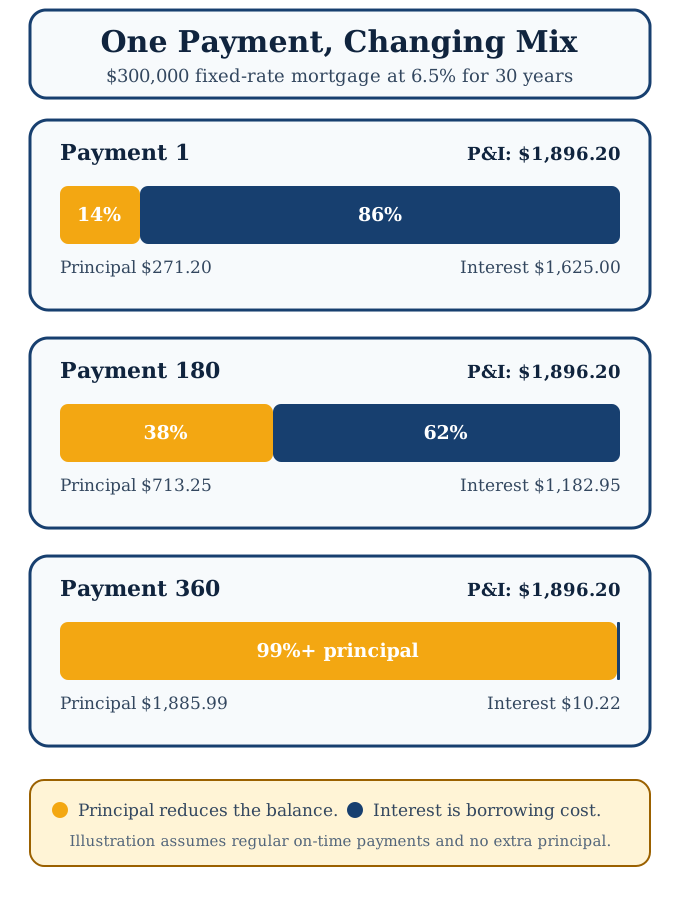
The illustration uses a $300,000, 30-year fixed-rate mortgage at 6.5% with a level scheduled P&I payment of about $1,896.20. Payment 1 applies about $271.20 to principal and $1,625.00 to interest. By payment 180, the principal share has increased to about $713.25. The final payment is almost entirely principal.
The total payment can still be larger if mortgage insurance or escrowed taxes and insurance apply. Those amounts do not drive the loan’s principal-interest amortization.
What Changes the Amortization Path
| Driver | Typical effect on balance reduction |
|---|---|
| Shorter amortization period | Requires faster principal reduction |
| Lower note rate | Leaves more of a given P&I payment available for principal |
| Extra principal payment | Moves the balance below the original schedule and reduces future interest |
| Interest-only period | Delays scheduled principal reduction |
| Negative amortization | Adds unpaid interest to principal and can increase the balance |
| ARM rate and payment adjustment | Recalculates payment using the new rate and remaining repayment period |
| Recast after a large principal reduction | Recalculates the required payment from the lower balance |
Practical Example
A borrower with the example loan makes only the scheduled payments. After 60 payments, the balance is about $280,833, so less than $20,000 of the original $300,000 principal has been retired despite more than $113,000 in P&I payments. Much of the early payment stream covered interest.
If the borrower makes a properly applied extra principal payment, the balance moves below the original schedule. Future interest is then calculated on less principal. Unless the loan is formally recast, the scheduled payment usually remains unchanged and the loan instead pays off earlier.
How It Differs From Nearby Terms
Amortization Period is the repayment span used in the payment calculation. Amortization is the process that occurs across that span.
An Amortization Schedule is the table showing projected payment allocation and remaining balance. It is a representation of the process, not the process itself.
Loan Term is the contractual time to maturity. It often matches the amortization period on a fully amortizing mortgage but can differ on a balloon structure.
Negative Amortization is the opposite balance direction: unpaid interest is added to principal, so the debt can grow even while payments are made.
Reamortization means recalculating a payment or repayment path from a current balance and remaining period. Ordinary amortization is the ongoing allocation under the existing schedule.
Related Terms
- Amortization Period
- Amortization Schedule
- Principal Payment
- Interest Payment
- Fully Amortizing Mortgage
- Negative Amortization
- Extra Principal Payment
- Mortgage Recast
Knowledge Check
- Why does the principal share usually rise on a level-payment fixed-rate mortgage? As scheduled principal reduction lowers the balance, less interest is due and more of the same P&I payment remains for principal.
- Does an escrow payment affect mortgage amortization? No. Escrow funds taxes and insurance; it does not reduce principal or pay loan interest.
- What usually happens after an extra principal payment if the loan is not recast? The required payment generally stays the same, future interest falls, and the loan can pay off sooner.