Mortgage-Backed Security
An investment security backed by a pool of mortgage loans.
A mortgage-backed security, often called an MBS, is an investment security backed by a pool of mortgage loans.
Why It Matters
An MBS matters because it helps explain why many mortgages are standardized, saleable, and priced inside a broad national market instead of being held only by the original lender.
It also matters because borrowers can mistake the term for a separate kind of mortgage product. It is not. The borrower signs an individual mortgage loan. The MBS is a security created later from a pool of many loans.
That distinction matters in practical ways. The existence of an active MBS market helps lenders keep making new loans, helps mainstream mortgage pricing stay connected to national capital markets, and helps explain why many loan programs follow standardized rules.
For ordinary borrowers, an MBS is mostly a behind-the-scenes funding structure, but it still affects what rates are available, which loans fit mainstream execution, and why a mortgage may be sold after closing without changing the original note terms.
Where It Appears in the Borrower Process
Borrowers usually encounter MBS concepts indirectly through rate behavior, Conforming Loan standards, loan-sale disclosures, and servicing-change notices after closing.
The term becomes practical when a borrower wants to understand how mortgage funding continues after closing and why one company may originate the loan while another later owns the economic interest or services the account.
It is especially useful when borrowers ask questions like:
- Why do mortgage rates move with bond-market conditions?
- Why are some loans easier to price than others?
- Why was my mortgage sold after closing?
Practical Example
A lender closes many similar mortgages, groups them into a pool, and that pool is used to back a security investors can buy. The borrower still has a mortgage on one home, but investors are now buying exposure to a pool of mortgages rather than to one single note.
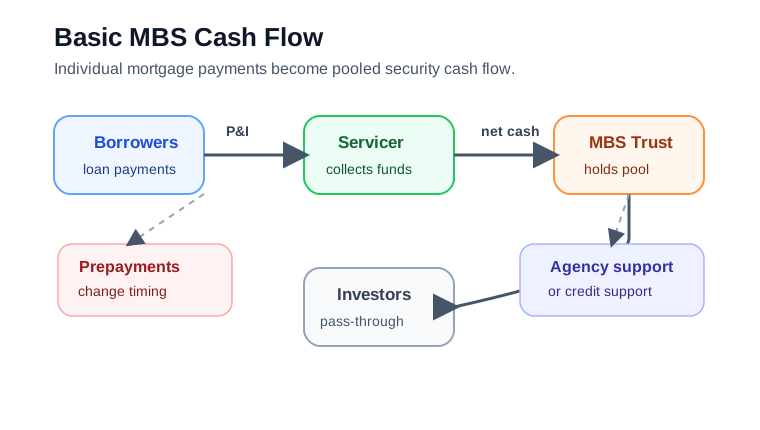
The basic cash-flow path is simple even when the transaction documents are complex: borrowers make payments, servicers collect and administer those payments, a trust or issuing structure organizes the pooled collateral, and investors receive security cash flow.
Basic MBS Building Blocks
| Building block | What it explains |
|---|---|
| Mortgage Pool | Group of loans behind the security |
| MBS Trust | Legal structure or vehicle holding mortgage collateral |
| MBS Issuer | Party responsible for issuing the security |
| MBS Trustee | Trustee role under the transaction documents |
| Pool Factor | How much of the original pool principal remains |
| Weighted Average Coupon | Balance-weighted underlying loan-rate profile |
| Weighted Average Maturity | Balance-weighted remaining scheduled maturity profile |
| Pass-Through Security | Direct pooled cash-flow structure |
| MBS Coupon | Security-level rate label tied to investor cash flow |
| Current Coupon in MBS | Market reference area near current production |
| MBS Price | Market value of the security |
| Pass-Through Rate | Cash-flow rate passed through to investors |
| REMIC | Common secondary-market structure behind many MBS deals |
| Collateralized Mortgage Obligation | Structured security that divides cash flows into classes |
| Credit Enhancement | Support feature used in some MBS structures |
| Prepayment Risk | Investor risk that loans pay off sooner than expected |
How It Differs From Nearby Terms
An MBS differs from Securitization because securitization is the process, while the MBS is the resulting security.
It also differs from a Whole Loan. A whole loan is an individual mortgage asset sold intact, while an MBS is backed by a pool of many loans.
It also differs from a Pass-Through Security. Mortgage-backed security is the broader category, while pass-through describes one common cash-flow structure inside that category.
It also differs from the Secondary Mortgage Market. The secondary market is the broader system where closed loans and securities trade, while an MBS is one product inside that system.
Related Terms
- Secondary Mortgage Market
- Securitization
- Mortgage Pool
- MBS Trust
- MBS Issuer
- Agency MBS
- Non-Agency MBS
- Pass-Through Security
Knowledge Check
- Is a mortgage-backed security the same thing as the mortgage loan the borrower signs? No. The borrower signs an individual mortgage, while the MBS is a security created later from many pooled loans.
- Why can MBS matter to a normal borrower who never buys securities? Because the MBS market helps shape mortgage funding, pricing, standardization, and what happens to loans after closing.