Fully Amortizing Mortgage
Mortgage whose scheduled principal-and-interest payments are designed to reduce the balance to zero by maturity.
A fully amortizing mortgage is a mortgage whose scheduled principal-and-interest payments are designed to repay the entire loan balance by the maturity date. If the borrower follows the schedule, no large unpaid principal balance remains at the end.
Why It Matters
Fully amortizing describes the repayment structure many borrowers expect from a standard mortgage: each scheduled payment covers the interest due and enough principal to keep the loan on its payoff path.
That structure is not universal. An interest-only feature can postpone principal reduction, while a balloon structure can end the loan before the balance has been fully repaid. Those loans may show a lower early payment without providing the same scheduled path to a zero balance.
Fully amortizing also does not mean fixed-rate. A fixed-rate mortgage can be fully amortizing, but so can an adjustable-rate mortgage if each recalculated payment is designed to repay the remaining balance over the remaining term.
Where It Appears in the Borrower Process
Borrowers encounter the concept while comparing loan products, reviewing the Projected Payments table on the Loan Estimate, and reading the note’s payment provisions. The Amortization Schedule shows how the payment pattern reduces principal over time.
On a standard fully amortizing loan, the Amortization Period generally matches the contractual term because the scheduled payments are designed to reach a zero balance at maturity.
Before closing, the borrower should ask:
- Does each scheduled payment include principal from the start?
- Can the principal-and-interest payment change later?
- Is any interest-only period built into the loan?
- Is a balloon payment due before the balance would otherwise reach zero?
- Does the schedule ever permit unpaid interest to increase the balance?
These questions distinguish the repayment path from the opening payment amount.
How the Balance Path Works
In a level-payment fixed-rate mortgage, the principal-and-interest payment may stay the same while its internal mix changes. Early payments generally contain more interest because the balance is larger. Later payments contain more principal as the balance falls.
In a fully amortizing ARM, the payment can be recalculated after a rate adjustment. The amount may rise or fall, but the new scheduled principal-and-interest payment is still calculated to retire the remaining balance over the remaining amortization period, subject to the loan terms.
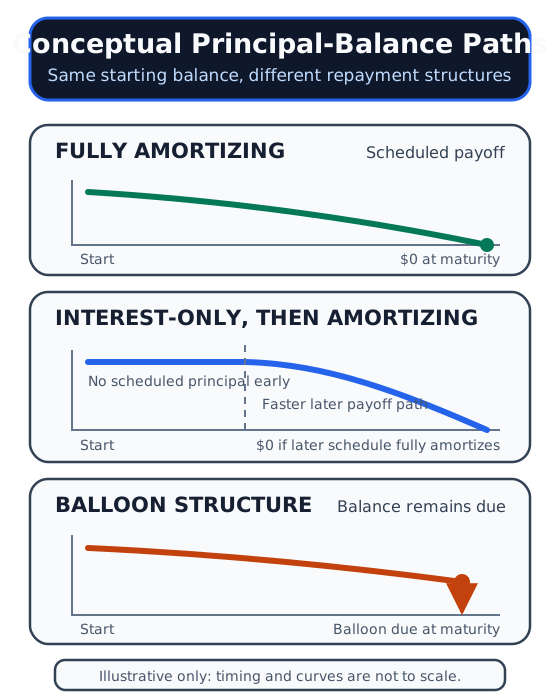
The diagram is conceptual rather than an amortization quote. Actual balances depend on the loan amount, rate, payment dates, extra principal, fees, modifications, and other contract terms.
Repayment Structures Compared
| Structure | Scheduled principal behavior | End-of-term issue |
|---|---|---|
| Fully amortizing mortgage | Principal declines under the scheduled payments | Balance is designed to reach zero |
| Interest-Only Mortgage | Principal is not required during the interest-only phase | Later payment must address principal over less time |
| Balloon Mortgage | Payments may reduce some principal | Large remaining balance comes due at maturity |
| Negative Amortization | Payment may not cover all accrued interest | Balance can increase rather than decline |
The label describes the required schedule, not what a borrower may do voluntarily. Extra principal can accelerate payoff, while missed or partial payments can move the account away from the original schedule.
Payment Stability Is a Separate Question
A fully amortizing mortgage can still have changing payments:
- an ARM rate reset can change principal and interest
- escrow analysis can change taxes-and-insurance deposits
- mortgage insurance can begin, end, or change under applicable terms
- a modification or reamortization can create a new schedule
The defining feature is scheduled payoff of principal by maturity, not a promise that every monthly bill will be identical.
Practical Example
A borrower closes a 30-year fixed-rate mortgage with 360 scheduled monthly principal-and-interest payments. The early payments reduce principal slowly because more of each payment covers interest. As the balance falls, the principal share grows.
If the borrower makes the required payments exactly as scheduled, the last payment retires the remaining principal rather than leaving a separate balloon amount. Property taxes or insurance may change during those 30 years without changing the loan’s fully amortizing structure.
How It Differs From Nearby Terms
Fully amortizing mortgage differs from Amortization. Amortization is the balance-reduction process; fully amortizing describes a payment structure designed to complete that process by maturity.
It differs from an Amortization Schedule, which is the period-by-period table showing the projected principal, interest, and balance.
It differs from Fixed-Rate Mortgage because fixed-rate describes interest-rate behavior. A mortgage can be fixed-rate and fully amortizing, adjustable-rate and fully amortizing, or fixed-rate with a balloon.
It also differs from Reamortization, which creates a revised payment schedule for an existing balance rather than naming the original repayment structure.
Related Terms
- Amortization
- Amortization Period
- Amortization Schedule
- Principal and Interest (P&I)
- Maturity Date
- Interest-Only Mortgage
- Balloon Mortgage
- Negative Amortization
- Reamortization
Knowledge Check
- What balance should remain at maturity if a fully amortizing mortgage is paid as scheduled? The scheduled principal balance should be zero, apart from any separate charges or account issues.
- Can an adjustable-rate mortgage be fully amortizing? Yes. Its payment can be recalculated to repay the remaining balance over the remaining term.
- Does fully amortizing mean the total monthly payment can never change? No. Rate adjustments, escrow changes, mortgage insurance, or later loan changes can alter the payment.