Combined Loan-to-Value Ratio (CLTV)
CLTV compares the first mortgage plus applicable subordinate debt with the property's underwriting value.
Combined loan-to-value ratio (CLTV) is the first mortgage plus applicable subordinate mortgage debt, divided by the property-value benchmark used in underwriting.
Why It Matters
CLTV reveals leverage that first-mortgage LTV can hide. A borrower may have an 80% first mortgage and still owe additional debt through a home equity loan, community second, or drawn HELOC balance. The lender evaluates the combined property-secured exposure rather than assuming the first lien is the only debt against the home.
CLTV can affect eligibility, pricing, subordinate-financing approval, refinance structure, and the amount of additional equity a borrower may access. No single maximum applies to every loan. Program, purpose, occupancy, property, credit, and lien rules determine the permitted result.
Where It Appears in the Borrower Process
CLTV appears when a purchase uses subordinate financing, when an existing second lien remains during refinance, or when a homeowner requests additional home-secured credit. The lender verifies each lien’s relevant balance, terms, payment, and position.
The ratio can change before closing if new subordinate financing appears, a HELOC draw changes, a second-lien payoff changes, or the value basis is revised. A first-mortgage approval does not make undisclosed or increased subordinate debt irrelevant.
CLTV Formula
Here, F is the first mortgage, S is applicable subordinate debt, and V is the property-value benchmark. For a closed-end second mortgage, the relevant amount is generally the applicable unpaid principal balance. For a HELOC, a CLTV convention may use the drawn balance, while HCLTV can use the full line limit. Program definitions control the actual calculation.
Practical Example
A property has a $400,000 underwriting value, a $320,000 first mortgage, and a $20,000 drawn balance on a HELOC.
The first-mortgage LTV is 80%, but combined leverage is 85%. If the HELOC has a $50,000 credit limit and the applicable analysis uses the full line, HCLTV would be 92.5%.
LTV, CLTV, and HCLTV
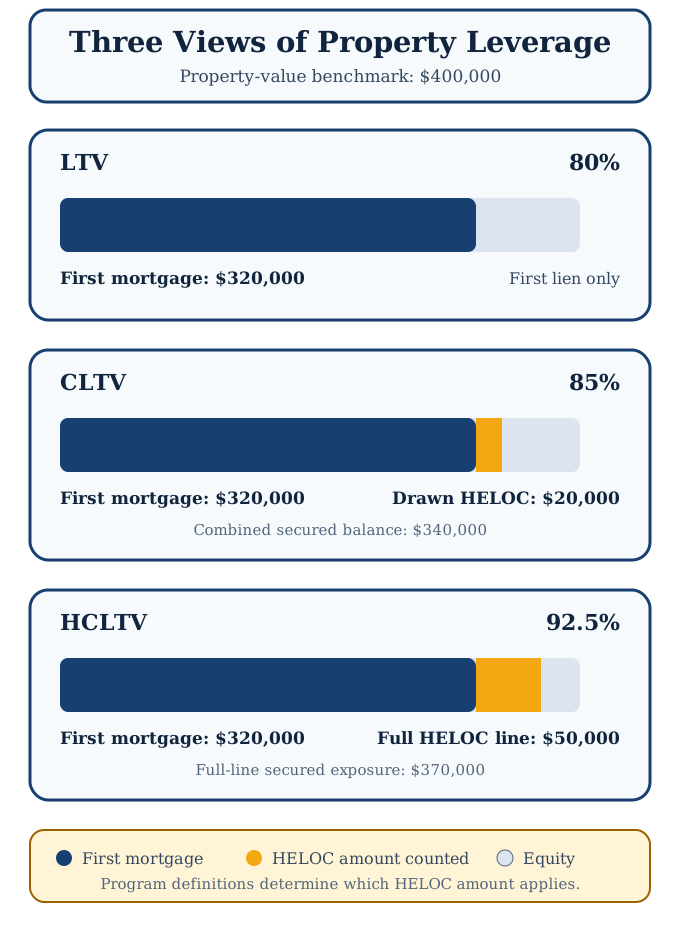
The illustration uses one property value so the numerator difference is easy to see. LTV counts the first mortgage, CLTV adds the drawn subordinate amount in this example, and HCLTV adds the full HELOC line. Actual loan-program definitions determine which balances belong in each calculation.
Subordinate Debt Commonly Reviewed
| Debt or arrangement | CLTV consideration |
|---|---|
| Closed-end home equity loan | Applicable unpaid principal balance is generally included |
| HELOC | Drawn balance or full line can matter depending on the ratio convention |
| Community second mortgage | Included when it is debt secured by the property under applicable rules |
| Seller-held subordinate lien | Terms, lien position, and permitted financing rules must be reviewed |
| Deferred-payment second | A zero current payment does not make the lien disappear from leverage |
| Unsecured personal loan | Not part of CLTV because it is not secured by the property, though it may affect DTI |
How It Differs From Nearby Terms
Loan-to-Value Ratio (LTV) uses the first mortgage only. CLTV combines applicable liens secured by the property.
Home Equity Combined Loan-to-Value Ratio (HCLTV) is designed to capture available HELOC exposure by using the full line amount under the applicable convention.
Maximum CLTV is a product or lender limit. CLTV is the calculated ratio for the actual transaction.
Lien Priority describes priority among liens. CLTV totals leverage without replacing the separate priority analysis.
Debt-to-Income Ratio (DTI) uses monthly payments and income. CLTV uses secured balances and property value.
Related Terms
- Loan-to-Value Ratio (LTV)
- Home Equity Combined Loan-to-Value Ratio (HCLTV)
- Maximum CLTV
- Junior Lien
- Second Mortgage
- Home Equity Loan
- Home Equity Line of Credit (HELOC)
- Lien Priority
Knowledge Check
- Why can CLTV be higher than first-mortgage LTV? CLTV adds applicable subordinate mortgage debt to the first mortgage.
- Does a deferred-payment second mortgage disappear from CLTV because no payment is currently due? No. CLTV measures property-secured balance exposure, not only current monthly payments.
- Why might HCLTV exceed CLTV on a property with a HELOC? HCLTV can use the full HELOC credit limit while CLTV may use only the drawn balance under the applicable convention.